




Token standards are the rulebook
They define who can hold the token, whether it can be transferred, how yield or dividends move, and how compliance is enforced on-chain.
Projects Delivered
Chains Supported
Years
Real World Asset tokenization takes ownership of something physical or financial — a property, a private credit fund, a bar of gold, a trade receivable — and represents it as a token on a blockchain. That token can then be split into smaller units, transferred programmatically, and made available to investors who'd otherwise never get access to that asset class.
The technology isn't the hard part. The hard part is choosing a token architecture that satisfies securities law, investor accreditation requirements, and jurisdiction-specific transfer rules — while still being liquid and usable. That's the layer most tokenization vendors gloss over, and it's the layer Eminence Technology builds first.
They define who can hold the token, whether it can be transferred, how yield or dividends move, and how compliance is enforced on-chain.

Using a plain utility-token standard for a security is the fastest way to trigger regulatory action.

Good standard selection means automated compliance, faster settlement, and a token that institutions are actually willing to hold.
Tokenized real-world assets have moved from a niche crypto experiment to a line item on the balance sheets of major asset managers. A few numbers worth knowing:
Multiple industry forecasts (BCG among them) put the tokenized asset market in the trillions by the early 2030s.
Well under 1% of global real estate value currently sits on-chain, leaving enormous room for fractional ownership models.
Tokenized assets can trade outside traditional market hours, unlike exchange-listed securities bound to fixed sessions.
On-chain settlement can compress multi-day settlement cycles (T+2 and similar) down to minutes, cutting counterparty risk.
Fractionalization brings previously six- and seven-figure minimum investments down to a few hundred dollars.
Major asset managers have launched or piloted tokenized funds, signaling this is infrastructure, not a trend.


The original fungible token standard. Every wallet, every exchange, every DeFi protocol supports it natively. For pure utility tokens or a fast proof-of-concept, it's still the simplest option on the table.
Purpose-built for regulated real-world assets. Identity verification, KYC/AML, and investor eligibility are embedded directly into the token contract, so every transfer is checked for compliance automatically.
Extends the ERC-3643 compliance model with programmable rules that can adapt per jurisdiction, in real time. Designed for issuers who need compliance logic that changes as regulations do — without redeploying the token.
A standardized interface for tokenized vaults — deposits, yield accrual, and withdrawals all follow one predictable pattern. It's less about compliance and more about making yield-bearing products interoperable across DeFi.
Adds a cross-chain interoperability layer on top of the compliance guarantees pioneered by ERC-3643, so a compliant security token can move and settle across multiple blockchain networks without breaking its regulatory logic.
This is where Eminence Technology's team has hands-on delivery experience — happy to walk through prior architecture decisions on a call.
If you need...
A fast proof-of-concept, no regulatory load
Utility TokensIf you need...
KYC/AML, investor whitelisting, securities compliance
Regulated RWAIf you need...
Automated yield, fund wrappers, DeFi-native returns
Yield ProductsIf you need...
Rules that change by jurisdiction, single-chain
Enterprise RWAIf you need...
The same compliant token live across multiple chains
Cross-chain RWA
Audited contracts across ERC-20, 3643, 4626, 7943, and 7518, with compliance modules built to spec.

KYC/AML integration, investor accreditation logic, and multi-jurisdiction rule sets baked into the contract layer.

Secondary market and trading infrastructure for issued tokens, white-labeled to your brand.

Guidance connecting your SPV structure and offering documents to the on-chain implementation (in partnership with your legal counsel).

Real-world data feeds, liquidity integrations, and cross-chain bridging where needed.

Positioning, investor-facing materials, and exchange/listing coordination for your token launch.
Every RWA project has a different mix of asset type, investor base, and regulatory footprint. Rather than guessing, get a short technical assessment from our team before you commit to an architecture.
Schedule A Call Today !Contact
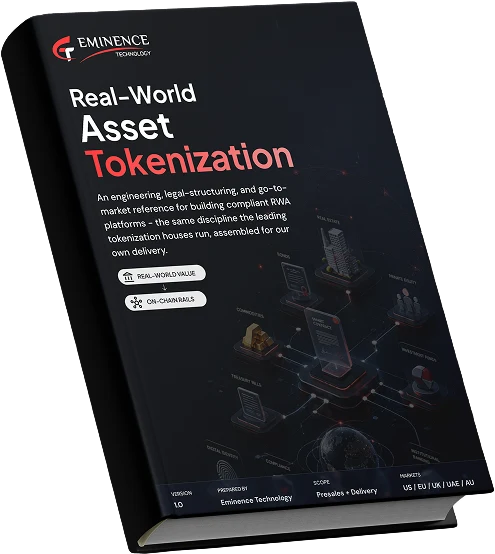
A practical reference for founders, counsel, and platform teams structuring a real-world asset offering. It breaks down the asset-class rules for real estate, precious metals, commodities, private equity, bonds, and funds, and the SPV, trust, and fund structures used to bind a token to the rights it's meant to represent.


